A trade carried by hand out of the Thar.
What the record shows about the setting, schooling and early experience that came before Narsi & Associates.
Nokha, Bikaner district — before 1981
The Suthar tradition
In Rajasthan, the Suthar community has long been associated with carpentry and woodwork; many families trace their identity to Vishwakarma, the divine craftsman of Hindu tradition. Narsi Kularia was born into this community, and the Vishwakarma Shakti Sangh Foundation records that he “inherited traditional woodworking skills” from it.1
That inheritance matters to how his career is described. Profiles do not present him as a financier or trained architect who entered interiors from outside, but as a craftsman who scaled a craft. Sourcing Hardware calls him a “first generation carpenter-turned-entrepreneur”.2 When his company’s work on the new Parliament was announced in 2023, Zee News reported congratulations from Vishwakarma and Suthar community groups across Rajasthan.3
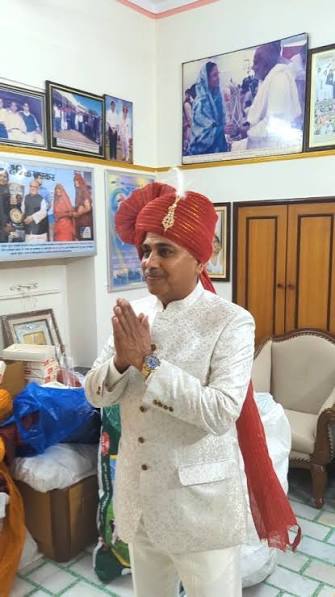
He continues to appear in community settings in the region. The photograph here shows him in a traditional red safa, greeting guests with folded hands.
A Grade 10 education, and then the workshop
Both of the principal profiles agree that his formal education ended at Grade 10.14 What followed was the kind of learning that does not appear on certificates: joinery, finishing and site work, learnt within a family trade and then on paid jobs.
This is also the context for his later work on skilling. The Furniture & Fittings Skill Council that he now chairs exists to give workers like the young Narsi Kularia — skilled but uncertified — a formal route to recognition and employment. In 2018 he told Patrika that giving carpenters and their craft a new identity was his group’s first priority (translated from Hindi).5
Nokha, Bikaner
Nokha is a town and administrative block in Bikaner district, in the Thar desert of north-western Rajasthan. Sources place Narsi Kularia’s origins in “Nokha village near Bikaner district” and, elsewhere, simply in “a village near Bikaner”.14
His family’s ties to the area remain visible. Reports of the 2024 healthcare centre refer to Seelwa and Moolwas in Nokha block, and in February 2026 a large religious gathering was held at “Narsi Villa”, described by the Thar Express as the orchard of Sant Shri Dularam Kularia in Silwa (Seelwa) village.67
The same district has figured in his skilling work: the first training camp under his group’s Skill India partnership was held in 2018 at Sanchar, and the associated skill exhibition and job fair took place at Bikaner’s Government Dungar College.5
India’s interiors in 1981
The industry he entered looked very different from the one he would help to shape.
India’s Interior Industry was at a primitive stage; it was the large oil companies that could afford large-scale Interior designing.
In the early 1980s, organised interior contracting in India was a narrow business. Large corporate fit-outs were rare, and much furniture and joinery work was done by independent carpenters and small workshops on a job-by-job basis. The economic liberalisation of 1991, and the growth of banking, IT and multinational offices that followed, would later create demand for the large-scale, deadline-driven fit-out work on which Narsi Group built its reputation.
According to Sangri Today, it was in this early period that he “polished his abilities to deliver what only a few could”.4
Three moves before the firm
-
1981
To Mumbai
He moved to Mumbai carrying, in the Vishwakarma Shakti Sangh Foundation’s words, “nothing but his carpentry skills and determination”, and began with small, family-run assignments.1
-
1983
To West Asia
An opportunity to work in West Asia followed. The project, in Oman according to one profile, gave him exposure to modern construction methods; Sangri Today notes that his “track record of honesty, consistency and timely project delivery” proved useful there.14
-
1985
Back to Mumbai
He returned in 1985 “with fresh ideas and a stronger foundation”. Within a year he had founded Narsi & Associates.4 Continue in the Journey chapter.
What is not documented. Public sources do not record Narsi Kularia’s date of birth, the names of his schools, or detailed accounts of his early apprenticeship. They are not supplied here.
Sources
- Vishwakarma Shakti Sangh Foundation, “Icons” profile of Narsi Kularia. vssfoundation.com
- Sourcing Hardware, “Narsi Kularia, Furniture & Fittings Skill Council: Skilling Strategies for Sustainable Growth”, 5 February 2023. sourcinghardware.net
- Zee News (Hindi), report on the new Parliament House interiors, 28 May 2023. zeenews.india.com
- Sangri Today, profile of Narsiram D Kularia, 3 June 2023. sangritoday.com
- Patrika (Hindi), conversation with Narsi Kularia, 28 September 2018. patrika.com
- ThePrint / ANI, report on the Sant Shri Dularam Kularia PHC, 7 August 2024. theprint.in
- Thar Express (Hindi), report on the Virat Hindu Dharm Sabha in Silwa, February 2026. tharexpressnews.com